Publications

World Engine: Towards the Era of Post-Training for Physical AI
Preview World Engine: Towards the Era of Post-Training for Physical AI

Tianyu Li*, Li Chen*, Hongyang Li*, Caojun Wang*, Haochen Liu*, Kashyap Chitta, Yuhang Lu, Naisheng Ye, Yufei Wang, Jiaxin Peng, Jin Pan, Zhaoyu Su, Peng Su, Andrei Bursuc, Shengbo Eben Li, Andreas Geiger, Honglin Bian

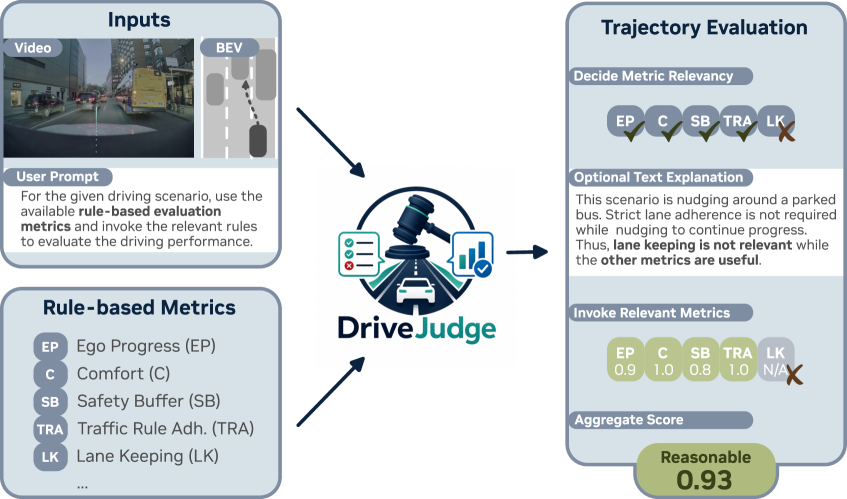
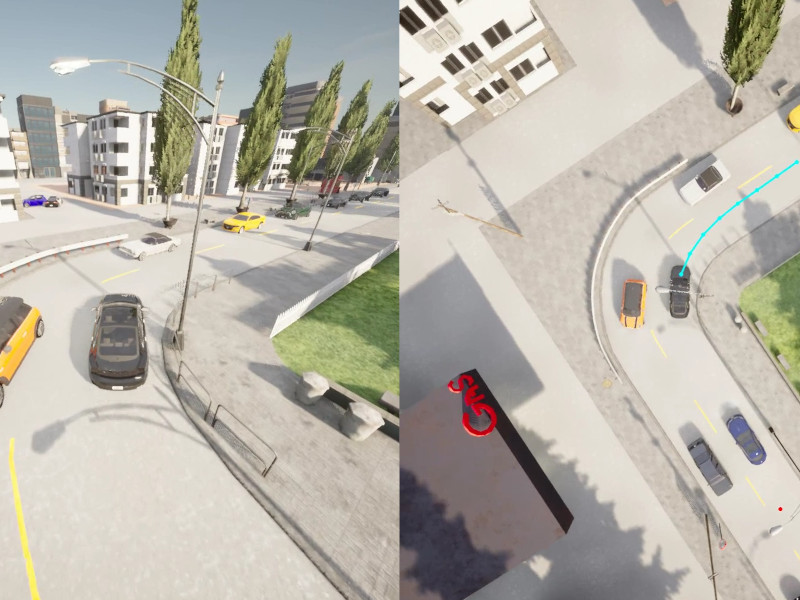
Physical AI systems, such as autonomous vehicles, must operate safely in the real world, where errors can have severe consequences. Although modern end-to-end driving policies excel in routine scenarios, their reliability is limited by the scarcity of safety-critical "long-tail" events in real driving datasets. These rare interactions define the practical safety boundary of the learned policy, yet they are difficult to collect at scale in the real world. Here we show that this fundamental limitation can be overcome by post-training pre-trained driving models on synthesized high-stakes interactions. We introduce World Engine, a generative framework that reconstructs high-fidelity interactive environments from real-world logs and systematically extrapolates them into realistic safety-critical variations. This paradigm enables reinforcement-based post-training to align policies with safety constraints, circumventing the physical risks inherent in real-world exploration. On a public benchmark built on nuPlan, World Engine substantially reduces failures in rare safety-critical scenarios and outperforms the gains obtained by scaling pre-training data alone. Furthermore, when deployed on a production-scale autonomous driving system, our approach reduces simulated collisions and demonstrates measurable improvements in on-road testing, showing that post-training on synthesized, safety-critical interactions offers a scalable and effective pathway to deploying safer Physical AI.

Project
123D: Unifying Multi-Modal Autonomous Driving Data at Scale
arXiv Preprint 123D: Unifying Multi-Modal Autonomous Driving Data at Scale

Daniel Dauner, Valentin Charraut, Bastian Berle, Tianyu Li, Long Nguyen, Jiabao Wang, Changhui Jing, Maximilian Igl, Holger Caesar, Boris Ivanovic, Yiyi Liao, Andreas Geiger, Kashyap Chitta

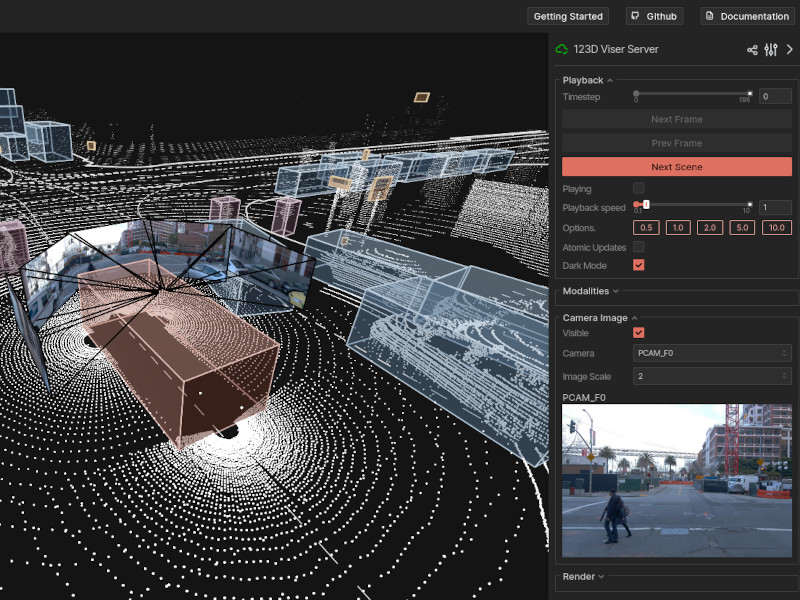
The pursuit of autonomous driving has produced one of the richest sensor data collections in all of robotics. However, its scale and diversity remain largely untapped. Each dataset adopts different 2D and 3D modalities, such as cameras, lidar, ego states, annotations, traffic lights, and HD maps, with different rates and synchronization schemes. They come in fragmented formats requiring complex dependencies that cannot natively coexist in the same development environment. Further, major inconsistencies in annotation conventions prevent training or measuring generalization across multiple datasets. We present 123D, an open-source framework that unifies such multi-modal driving data through a single API. To handle synchronization, we store each modality as an independent timestamped event stream with no prescribed rate, enabling synchronous or asynchronous access across arbitrary datasets. Using 123D, we consolidate eight real-world driving datasets spanning 3,300 hours and 90,000 kilometers, together with a synthetic dataset with configurable collection scripts, and provide tools for data analysis and visualization. We conduct a systematic study comparing annotation statistics and assessing each dataset's pose and calibration accuracy. Further, we showcase two applications 123D enables: cross-dataset 3D object detection transfer and reinforcement learning for planning, and offer recommendations for future directions.

arXiv Project
ReSplat: Learning Recurrent Gaussian Splatting
arXiv Preprint ReSplat: Learning Recurrent Gaussian Splatting

Haofei Xu, Daniel Barath, Andreas Geiger, Marc Pollefeys

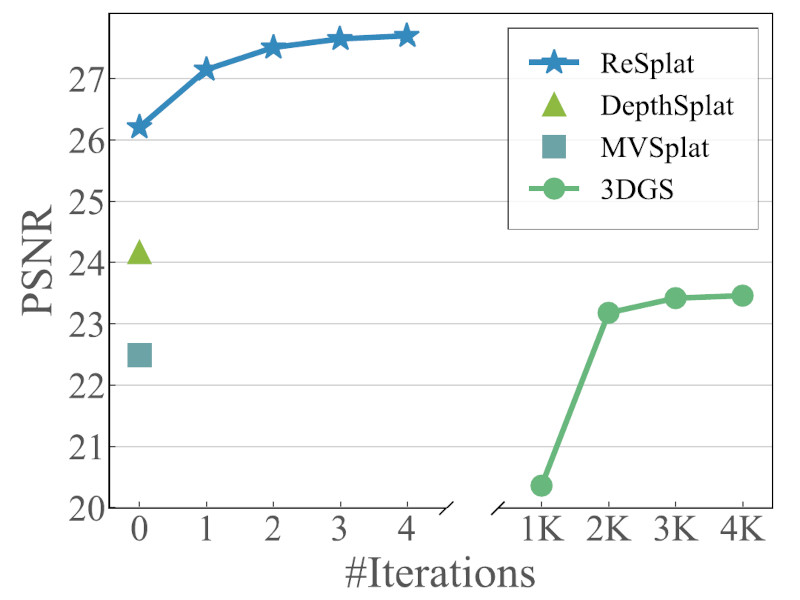
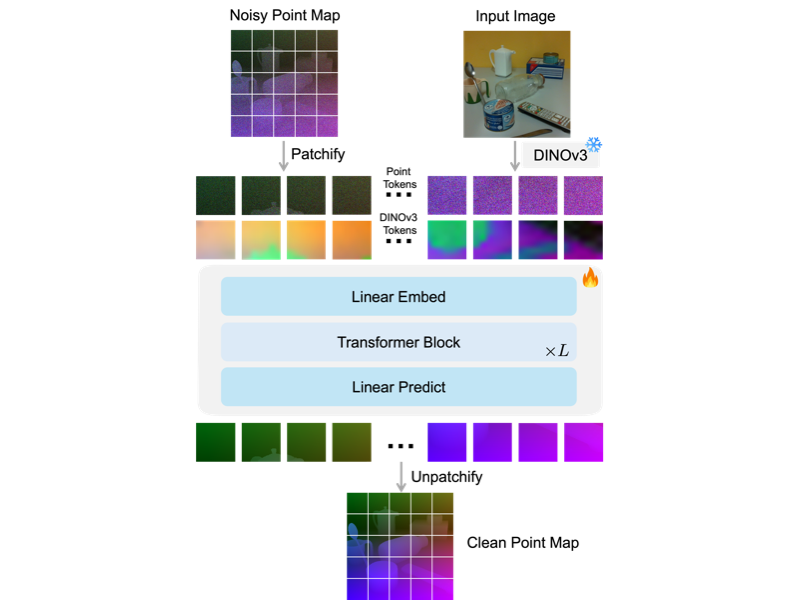
While existing feed-forward Gaussian splatting models offer computational efficiency and can generalize to sparse view settings, their performance is fundamentally constrained by relying on a single forward pass for inference. We propose ReSplat, a feed-forward recurrent Gaussian splatting model that iteratively refines 3D Gaussians without explicitly computing gradients. Our key insight is that the Gaussian splatting rendering error serves as a rich feedback signal, guiding the recurrent network to learn effective Gaussian updates. This feedback signal naturally adapts to unseen data distributions at test time, enabling robust generalization across datasets, view counts, and image resolutions. To initialize the recurrent process, we introduce a compact reconstruction model that operates in a 16× subsampled space, producing 16× fewer Gaussians than previous per-pixel Gaussian models. This substantially reduces computational overhead and allows for efficient Gaussian updates. Extensive experiments across varying number of input views (2, 8, 16, 32), resolutions (256×256 to 540×960), and datasets (DL3DV, RealEstate10K, and ACID) demonstrate that our method achieves state-of-the-art performance while significantly reducing the number of Gaussians and improving the rendering speed.

arXiv Project
LEAD: Minimizing Learner-Expert Asymmetry in End-to-End Driving
CVPR 2026 LEAD: Minimizing Learner-Expert Asymmetry in End-to-End Driving

Long Nguyen, Micha Fauth, Bernhard Jaeger, Daniel Dauner, Maximilian Igl, Andreas Geiger, Kashyap Chitta

Simulators can generate virtually unlimited driving data, yet imitation learning policies in simulation still struggle to achieve robust closed-loop performance. Motivated by this gap, we empirically study how misalignment between privileged expert demonstrations and sensor-based student observations can limit the effectiveness of imitation learning. More precisely, experts have significantly higher visibility (e.g., ignoring occlusions) and far lower uncertainty (e.g., knowing other vehicles' actions), making them difficult to imitate reliably. Furthermore, navigational intent (i.e., the route to follow) is under-specified in student models at test time via only a single target point. We demonstrate that these asymmetries can measurably limit driving performance in CARLA and offer practical interventions to address them. After careful modifications to narrow the gaps between expert and student, our TransFuser v6 (TFv6) student policy achieves a new state of the art on all major publicly available CARLA closed-loop benchmarks, reaching 95 DS on Bench2Drive and more than doubling prior performances on Longest6~v2 and Town13. Additionally, by integrating perception supervision from our dataset into a shared sim-to-real pipeline, we show consistent gains on the NAVSIM and Waymo Vision-Based End-to-End driving benchmarks.

arXiv Project
PrITTI: 3D urban scene generation using primitive-based representation
CVPR 2026 PrITTI: Primitive-based Generation of Controllable and Editable 3D Semantic Urban Scenes

Christina Ourania Tze, Daniel Dauner, Yiyi Liao, Dzmitry Tsishkou, Andreas Geiger

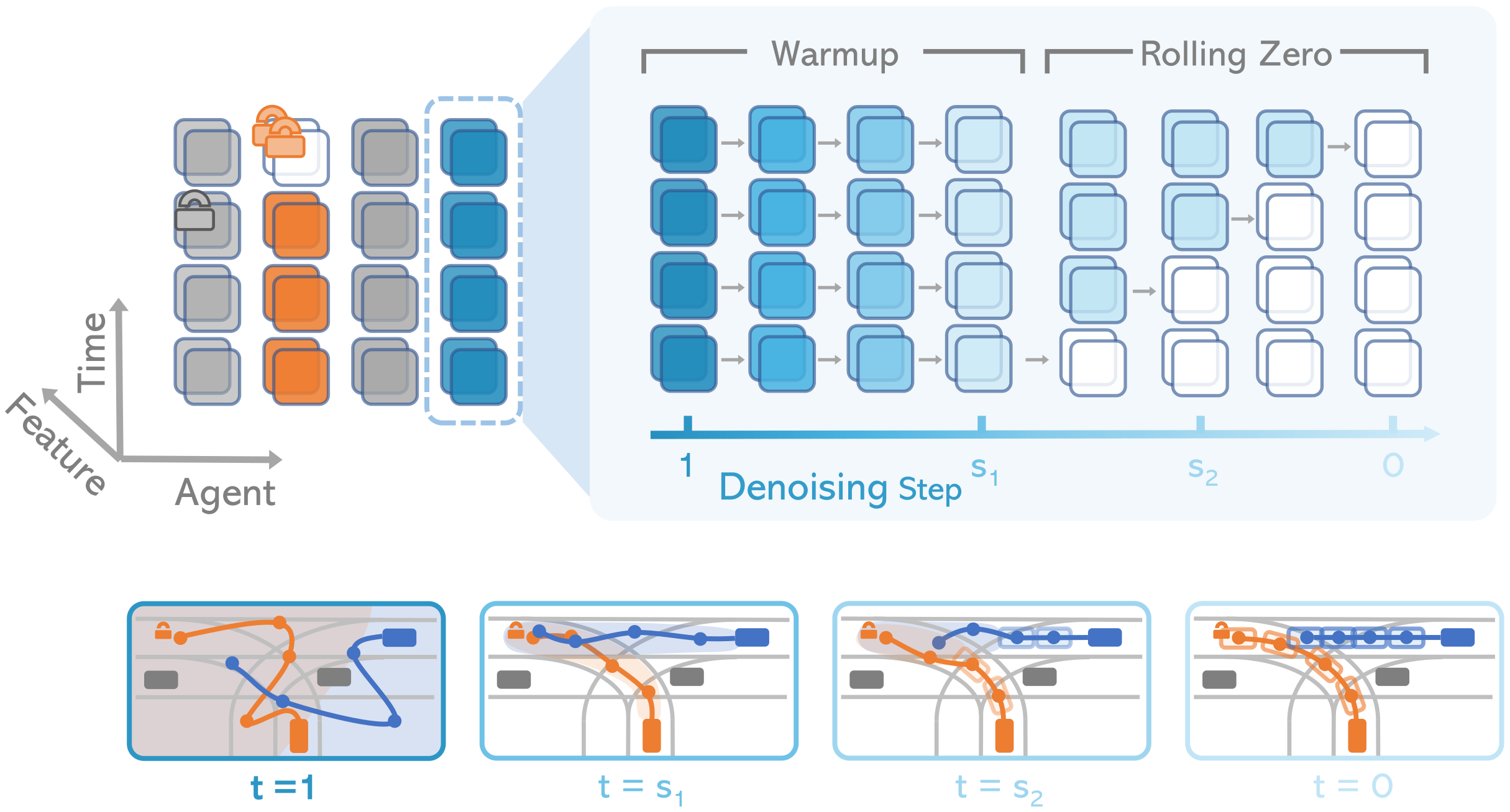
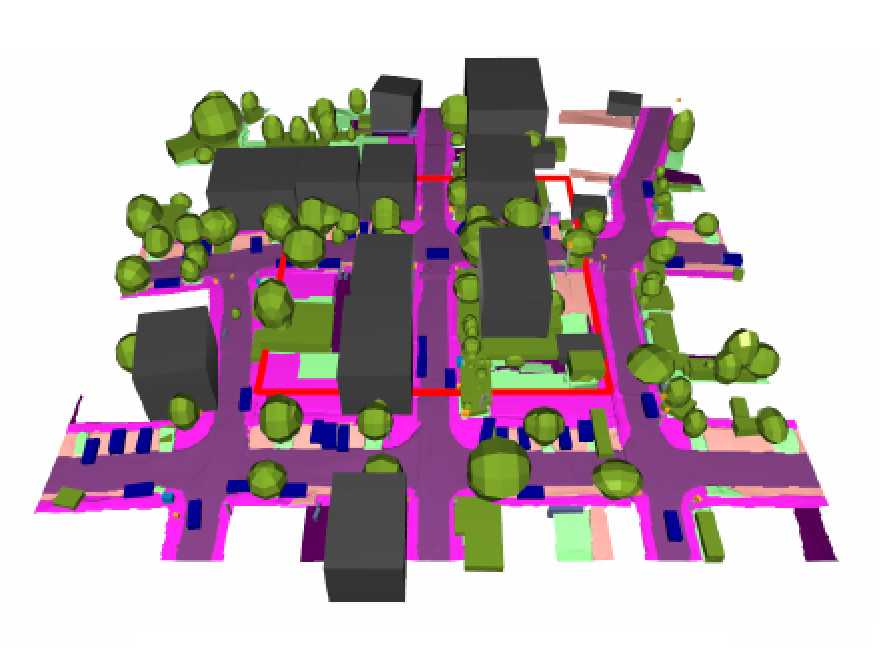
Existing approaches to 3D semantic urban scene generation predominantly rely on voxel-based representations, which are bound by fixed resolution, challenging to edit, and memory-intensive in their dense form. In contrast, we advocate for a primitive-based paradigm where urban scenes are represented using compact, semantically meaningful 3D elements that are easy to manipulate and compose. To this end, we introduce PrITTI, a latent diffusion model that leverages vectorized object primitives and rasterized ground surfaces for generating diverse, controllable, and editable 3D semantic urban scenes. This hybrid representation yields a structured latent space that facilitates object- and ground-level manipulation. Experiments on KITTI-360 show that primitive-based representations unlock the full capabilities of diffusion transformers, achieving state-of-the-art 3D scene generation quality with lower memory requirements, faster inference, and greater editability than voxel-based methods. Beyond generation, PrITTI supports a range of downstream applications, including scene editing, inpainting, outpainting, and photo-realistic street-view synthesis.

arXiv Project