Press Release · May 20, 2026
Kyutai and ELLIS Tübingen launch KE:SAI: A Premier Franco-German Partnership for Open Science in Physical AI
TÜBINGEN, Germany & PARIS, France – May 20, 2026
Kyutai and ELLIS Tübingen announce the official launch of KE:SAI – Kyutai ELLIS Scalable Autonomous Intelligence. KE:SAI is a non-profit open science research laboratory dedicated to the next frontier of artificial intelligence: systems that can understand and act in the real world. KE:SAI brings together two of Europe’s most prominent AI brands to address the fundamental challenges of world models and physical AI. Founded in Paris in 2023, Kyutai has emerged as one of Europe’s leading AI laboratories, with a focus on breakthrough research with immediate and lasting impact, and a team driven by a shared commitment to openness and excellence. It was originally funded by the iliad Group, CMA CGM and Eric and Wendy Schmidt’s philanthropy. The ELLIS Institute Tübingen has established itself as a leading center for foundational AI research, attracting top machine learning talent and providing state-of-the-art facilities in Tübingen, Germany. Funded by the Hector Foundation and the State of Baden-Württemberg, and collaborating closely with the Max Planck Institute for Intelligent Systems and the Tübingen AI Center at the University of Tübingen, it is part of the European Laboratory for Learning and Intelligent Systems, a pan-European network of excellence in machine learning.
KE:SAI has offices in Tübingen and Paris. It provides the specialized resources necessary to conduct world-class frontier research in physical intelligence, including high-performance compute infrastructure and hardware prototyping. By integrating foundational open research and the agility of modern startups, KE:SAI will develop a fully open technology stack for physical AI. Unlike related areas of AI, where sharing of algorithms and models triggered an explosion of innovation, physical AI has yet to benefit from this flywheel. KE:SAI’s mission is to accelerate this transition and democratize physical AI. With Europe’s ecosystem of global automotive and manufacturing leaders, KE:SAI’s open science approach will rapidly translate to real-world industrial scale, establishing itself at the forefront of open-source physical AI.
The research is led by a founding team of renowned experts: Andreas Geiger (CEO), Kashyap Chitta (CTO), and Bernhard Schölkopf, alongside co-founders Bernhard Jaeger and Daniel Dauner. The team’s work centers on the development of compact representations of the real world to enable data- and compute efficient robot learning in simulation. This approach will reduce the cost of physical interaction, enabling deployment of physical intelligence to a wide range of robotic systems and environments. KE:SAI’s first milestone will be the development of a fully open self-driving stack with frontier performance which will help democratize self-driving technology. KE:SAI’s work will also pave the way towards autonomous intelligence across other areas of robotics, extending to manufacturing and medical robotics. Initial funding for KE:SAI is provided by Kyutai. KE:SAI is actively hiring researchers, engineers and PhD students in both Tübingen and Paris.
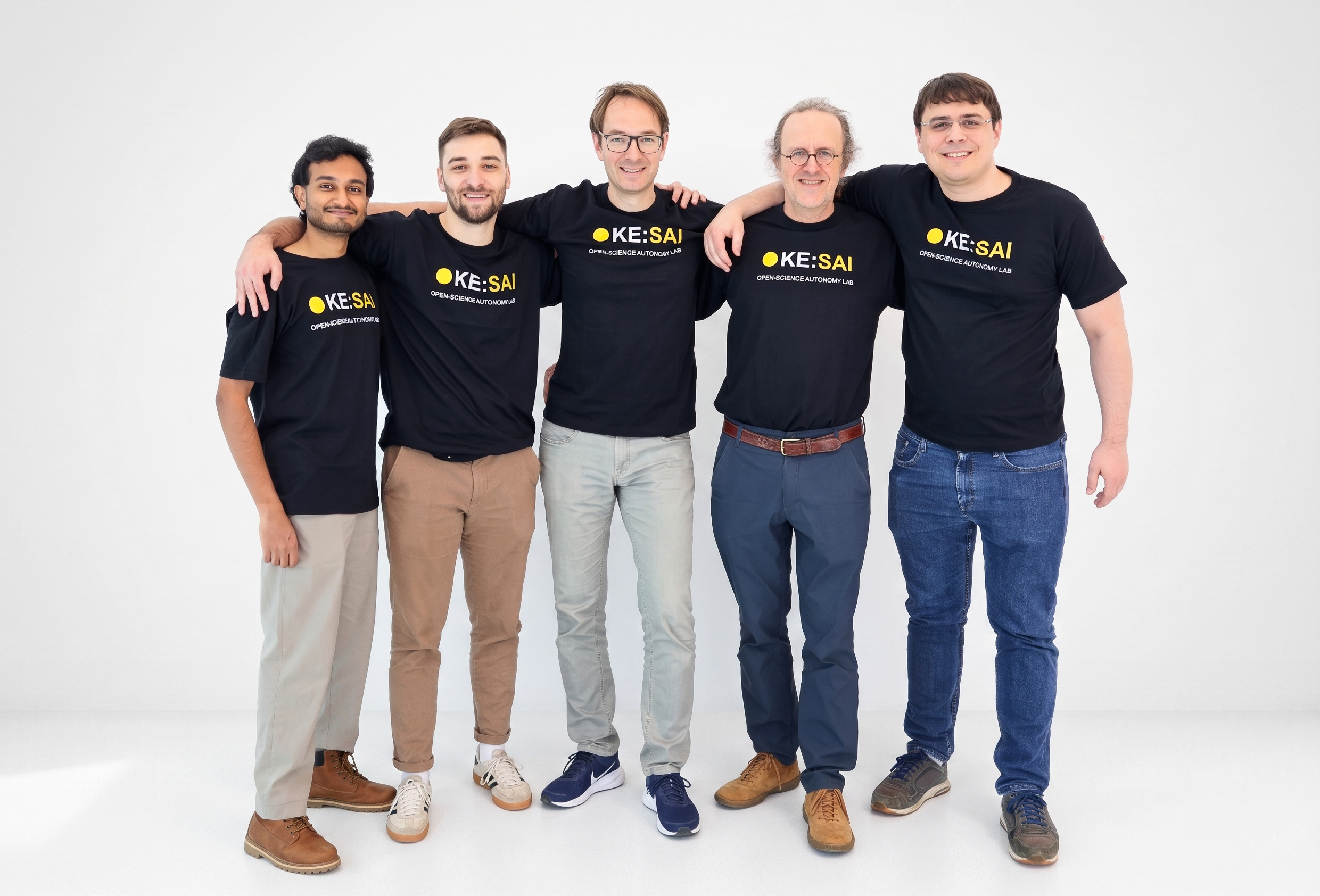
Co-founders of KE:SAI. From left to right:
Kashyap Chitta, Daniel Dauner, Andreas Geiger, Bernhard Schölkopf, Bernhard Jaeger
“KE:SAI explores how data-efficient world models can make machine learning for autonomous systems simpler and more cost-effective. This opens up entirely new possibilities for deploying such systems across a wide range of applications.”
Andreas Geiger, CEO of KE:SAI and Professor at the University of Tübingen and the Tübingen AI Center
“Combining the leading open-science ethos of Kyutai with the research excellence of the ELLIS network, KE:SAI will be a unique frontier lab where fundamental questions in machine learning lead to scalable, open-source breakthroughs in world modeling.”
Bernhard Schölkopf, Scientific Director of the ELLIS Institute Tübingen and Max Planck Institute for Intelligent Systems
“AI is moving beyond screens and digital interfaces into the physical world, reshaping industries. With KE:SAI, Kyutai is expanding its capacity to develop and ship frontier AI research and models, asserting Europe’s leadership in the field.”
Alexandre Défossez, Co-founder of Kyutai
“I am delighted that Kyutai, the internationally renowned AI research lab based in Paris, is now setting up shop in our AI ecosystem in Tübingen. We extend a warm welcome to them! Bienvenue and welcome. Kyutai’s establishment in Tübingen demonstrates that Baden-Württemberg is at the heart of European AI research. In Tübingen, brilliant minds meet first-class infrastructure. In addition to the Cyber Valley Innovation Campus, with the ELLIS Institute, the Max Planck Institute, and the participating universities, our innovation landscape includes other powerhouses such as the IPAI in Heilbronn or the AI Factory HammerHAI, to name just a few highlights. With the new KE:SAI research lab, top-tier talent is now advancing outstanding research excellence in the fields of 3D computer vision, data-driven simulation, causality, and physical AI. Kyutai and Baden-Württemberg are focusing on scientific excellence to enable world-leading AI research with the goal of achieving Europe’s digital sovereignty. I thank everyone involved who contributed to this success.”
Cem Özdemir, Minister-President of Baden-Württemberg
Further Links
- KE:SAI Website: kesai.eu
- KE:SAI Hiring: talent@kesai.eu
- KE:SAI Press: press@kesai.eu
- Kyutai Website: kyutai.org
- ELLIS Institute Tübingen Website: institute-tue.ellis.eu
Pressemitteilung · 20. Mai 2026
Kyutai und ELLIS Tübingen gründen KE:SAI: Eine deutsch-französische Partnerschaft für Open Science in der physischen KI
TÜBINGEN, Deutschland & PARIS, Frankreich – 20. Mai 2026
Kyutai und ELLIS Tübingen geben den offiziellen Start von KE:SAI – Kyutai ELLIS Scalable Autonomous Intelligence bekannt. KE:SAI ist ein gemeinnütziges Open-Science Forschungslabor, das sich der nächsten Herausforderung der Künstlichen Intelligenz widmet: Systeme, welche die reale Welt verstehen und in ihr agieren können. KE:SAI bringt zwei der bekanntesten KI-Marken Europas zusammen, um die grundlegenden Herausforderungen von Weltmodellen und physischer KI anzugehen. Kyutai wurde 2023 in Paris gegründet und hat sich zu einem der führenden KI-Labore Europas entwickelt, mit einem Fokus auf bahnbrechender Forschung, getragen von einem Team, das sich gemeinsam für Offenheit und Exzellenz einsetzt. Kyutai wurde von der iliad Group, CMA CGM und Eric and Wendy Schmidt’s Philanthropy finanziert. Das ELLIS Institut Tübingen hat sich als führendes Zentrum für KI-Grundlagenforschung etabliert, das Top-Talente im Bereich des maschinellen Lernens anzieht und hochmoderne Einrichtungen zur Verfügung stellt. Es wird von der Hector Stiftung und dem Land Baden-Württemberg finanziert und arbeitet eng mit dem Max-Planck-Institut für Intelligente Systeme sowie dem Tübingen AI Center an der Universität Tübingen zusammen. Es ist Teil des European Laboratory for Learning and Intelligent Systems, einem paneuropäischen Exzellenznetzwerk für maschinelles Lernen.
KE:SAI verfügt über Standorte in Tübingen und Paris. Es stellt die notwendigen Ressourcen bereit, um Spitzenforschung im Bereich der physischen Intelligenz möglich zu machen. Durch die Kombination von offener Forschung mit der Agilität moderner Start-ups wird KE:SAI einen offenen technologischen Ansatz für physische KI entwickeln. Im Gegensatz zu verwandten KI-Bereichen, in denen offene Algorithmen und Modelle maßgeblich Innovation vorangetrieben haben, hat die physische KI bisher noch vergleichsweise wenig von diesem Synergieeffekt profitiert. Die Mission von KE:SAI ist es, diesen Übergang zu beschleunigen und physische KI zu demokratisieren. Mithilfe des europäischen Ökosystems aus globalen Spitzenunternehmen der Automobil- und Fertigungsindustrie können die von KE:SAI entwickelten Modelle schnell in die industrielle Praxis überführt werden.
Die Forschung wird von einem Gründerteam renommierter Experten geleitet: Andreas Geiger (CEO), Kashyap Chitta (CTO), Bernhard Schölkopf, Bernhard Jaeger und Daniel Dauner. Die Arbeit des Teams konzentriert sich auf die Entwicklung kompakter Repräsentationen der realen Welt, um daten- und recheneffizientes Lernen in Simulationen zu ermöglichen. Dieser Ansatz wird die Kosten für physische Interaktionen senken und den Einsatz künstlicher Intelligenz in einer Vielzahl von Robotersystemen und Umgebungen ermöglichen. Der erste Meilenstein von KE:SAI wird die Entwicklung eines leistungsfähigen und vollständig offenen Systems für autonomes Fahren sein, was zur Demokratisierung dieser Technologie beitragen wird. Die Arbeit von KE:SAI wird zudem den Weg für autonome Intelligenz in anderen Bereichen der Robotik ebnen, bis hin zur Fertigungstechnik und der Medizinrobotik. Die Anschubfinanzierung für KE:SAI wird von Kyutai bereitgestellt. KE:SAI stellt derzeit aktiv Forscher, Ingenieure und Doktoranden sowohl in Tübingen als auch in Paris ein.
Gründer von KE:SAI. Von links nach rechts:
Kashyap Chitta, Daniel Dauner, Andreas Geiger, Bernhard Schölkopf, Bernhard Jaeger
„KE:SAI erforscht wie dateneffiziente Weltmodelle das maschinelle Lernen autonomer Systeme einfacher und kostengünstiger machen können. Damit eröffnen sich völlig neue Möglichkeiten, solche Systeme in unterschiedlichsten Anwendungen zum Einsatz zu bringen.“
Andreas Geiger, Geschäftsführer von KE:SAI und Professor an der Universität Tübingen und dem Tübingen AI Center
„Durch die Kombination des Open-Science-Ethos von Kyutai mit der Forschungsexzellenz des ELLIS-Netzwerks wird KE:SAI ein einzigartiges Spitzenlabor sein, in dem grundlegende Fragen des maschinellen Lernens zu skalierbaren offenen Durchbrüchen im Bereich der Weltmodellierung führen.“
Bernhard Schölkopf, Wissenschaftlicher Direktor des ELLIS Institute Tübingen und des Max-Planck-Instituts für Intelligente Systeme
„KI entwickelt sich über Bildschirme und digitale Schnittstellen hinaus in die physische Welt und verändert viele Industriebereiche grundlegend. Mit KE:SAI erweitert Kyutai seine Ambitionen, Spitzenforschung und -modelle im Bereich der KI zu entwickeln und zu veröffentlichen, und bekräftigt damit die europäische Führung in diesem Feld.“
Alexandre Défossez, Mitbegründer von Kyutai
„Ich freue mich außerordentlich, dass sich das international renommierte KI-Forschungslabor Kyutai mit Sitz in Paris nun auch in unserem KI-Ökosystem in Tübingen niederlassen wird. Wir heißen sie herzlich willkommen! Bienvenue and welcome. Die Ansiedlung von Kyutai in Tübingen zeigt: Baden-Württemberg ist Herz der europäischen KI-Forschung. In Tübingen treffen exzellente Köpfe auf eine erstklassige Infrastruktur. Neben dem Innovationscampus Cyber Valley, mit dem ELLIS Institut, dem Max-Planck-Institut und den beteiligten Universitäten, gehören zu unserer Innovationslandschaft weitere Hot Spots wie das IPAI in Heilbronn oder die AI Factory HammerHAI, um nur einige Highlights zu nennen. Mit dem neuen KE:SAI-Forschungslabor kommen zusätzliche Talente nach Baden-Württemberg und treiben dadurch die herausragende Forschung in den Bereichen 3D Computer Vision, datengetriebene Simulation, Kausalität und physische KI weiter voran. Kyutai und Baden-Württemberg richten den Fokus auf wissenschaftliche Exzellenz, um weltweit führende KI-Forschung – mit dem Ziel der digitalen Souveränität Europas – zu ermöglichen. Ich danke allen Mitwirkenden, die zu diesem Erfolg beigetragen haben.“
Cem Özdemir, Ministerpräsident von Baden-Württemberg
Weiterführende Links
- KE:SAI Website: kesai.eu
- KE:SAI Karriere: talent@kesai.eu
- KE:SAI Presse: press@kesai.eu
- Kyutai Website: kyutai.org
- ELLIS Institute Tübingen Website: institute-tue.ellis.eu
Communiqué de presse · 20 mai 2026
Kyutai et l’ELLIS Institute Tübingen lancent KE:SAI : un partenariat franco-allemand de premier plan pour l’IA physique en open science
TÜBINGEN, Allemagne & PARIS, France – le 20 mai 2026
Kyutai et l’ELLIS Institute Tübingen annoncent le lancement officiel de KE:SAI – Kyutai ELLIS Scalable Autonomous Intelligence. KE:SAI est un laboratoire de recherche à but non lucratif dédié à la prochaine grande étape de l’intelligence artificielle : des systèmes capables de comprendre, anticiper et agir dans le monde réel. KE:SAI réunit deux des acteurs les plus reconnus de l’IA en Europe afin de relever les défis fondamentaux liés aux world models et à l’IA physique. Fondé à Paris en 2023, Kyutai s’est rapidement imposé comme l’un des principaux laboratoires européens d’intelligence artificielle, grâce à des travaux de recherche de rupture conçus pour avoir un impact concret et durable. Le laboratoire réunit une équipe portée par une même exigence d’excellence et d’ouverture. Kyutai a initialement été financé par le groupe iliad, CMA CGM et Eric and Wendy Schmidt’s philanthropy. L’ELLIS Institute Tübingen s’est, de son côté, établi comme un centre de référence en recherche fondamentale sur l’IA. L’institut attire des talents de premier plan en machine learning et bénéficie d’infrastructures de pointe à Tübingen, en Allemagne. Financé par la Fondation Hector et le Land du Bade-Wurtemberg, et collaborant étroitement avec le Max Planck Institute for Intelligent Systems ainsi que l’Université de Tübingen, l’institut fait partie du European Laboratory for Learning and Intelligent Systems (ELLIS), un réseau paneuropéen d’excellence dédié au machine learning.
KE:SAI dispose de bureaux à Tübingen et à Paris. Le laboratoire met à disposition les ressources spécialisées nécessaires à une recherche de pointe en intelligence physique, notamment des infrastructures de calcul haute performance et des capacités de prototypage matériel. En combinant recherche fondamentale ouverte et agilité des startups modernes, KE:SAI développera une infrastructure logicielle entièrement ouverte dédiée à l’IA physique. Alors que le partage des algorithmes et des modèles a contribué à accélérer l’innovation dans d’autres domaines de l’IA, l’IA physique n’a pas encore bénéficié de cette dynamique. La mission de KE:SAI est précisément d’accélérer cette transition et de démocratiser l’IA physique. Grâce à l’écosystème européen composé de leaders mondiaux de l’automobile et de l’industrie manufacturière, l’approche de science ouverte de KE:SAI pourra rapidement être déployée à l’échelle industrielle et contribuer à positionner l’Europe à l’avant-garde de l’IA physique open source.
La recherche est pilotée par une équipe fondatrice composée d’experts reconnus : Andreas Geiger (CEO), Kashyap Chitta (CTO) et Bernhard Schölkopf, aux côtés des cofondateurs Bernhard Jaeger et Daniel Dauner. Les travaux de l’équipe portent sur le développement de représentations compactes du monde réel afin de rendre l’apprentissage robotique en simulation plus efficace, tant en données qu’en puissance de calcul. Cette approche vise à réduire le coût des interactions physiques, ouvrant ainsi la voie au déploiement de l’intelligence physique dans une large variété d’environnements et de systèmes robotiques. La première étape majeure pour KE:SAI sera le développement d’une pile technologique de conduite autonome entièrement ouverte, dotée de performances de pointe afin de démocratiser l’accès aux technologies de conduite autonome. Les travaux du laboratoire ouvriront également la voie à une intelligence autonome dans d’autres domaines de la robotique, notamment dans l’industrie manufacturière et la robotique médicale. Le financement initial de KE:SAI est assuré par Kyutai. Le laboratoire recrute actuellement des chercheurs, ingénieurs et doctorants à Tübingen et à Paris.
Cofondateurs de KE:SAI, de gauche à droite :
Kashyap Chitta, Daniel Dauner, Andreas Geiger, Bernhard Schölkopf, Bernhard Jaeger
« KE:SAI fournit l’infrastructure essentielle pour démontrer que des modèles du monde sobres en données peuvent transformer en profondeur la manière dont les systèmes autonomes apprennent à interagir avec des environnements complexes du monde réel. »
Andreas Geiger, CEO de KE:SAI et professeur à l’Université de Tübingen ainsi qu’au Tübingen AI Center
« En associant la culture de la science ouverte portée par Kyutai à l’excellence scientifique du réseau ELLIS, KE:SAI constituera un laboratoire de pointe unique, où les questions fondamentales du machine learning donneront naissance à des avancées ouvertes et évolutives dans la modélisation du monde. »
Bernhard Schölkopf, directeur scientifique de l’ELLIS Institute Tübingen et du Max Planck Institute for Intelligent Systems
« L’IA dépasse désormais les écrans et les interfaces numériques pour s’ancrer dans le monde physique et transformer les industries. Avec KE:SAI, Kyutai renforce sa capacité à développer et déployer des travaux de recherche et modèles d’IA de pointe, tout en affirmant le leadership de l’Europe dans ce domaine. »
Alexandre Défossez, cofondateur de Kyutai
« Je me réjouis que Kyutai, le laboratoire de recherche en IA de renommée internationale basé à Paris, rejoigne notre écosystème IA à Tübingen. Nous lui souhaitons la bienvenue. Cette nouvelle implantation confirme que le Bade-Wurtemberg se trouve au cœur de la recherche européenne en intelligence artificielle. À Tübingen, des chercheurs de haut niveau s’appuient sur des infrastructures d’excellence. Aux côtés du campus d’innovation Cyber Valley, avec l’ELLIS Institute, le Max Planck Institute et les universités partenaires, notre écosystème d’innovation compte également d’autres acteurs majeurs tels que l’IPAI à Heilbronn ou encore l’AI Factory HammerHAI. Avec le nouveau laboratoire de recherche KE:SAI, des talents de premier plan feront progresser la recherche dans les domaines de la vision par ordinateur 3D, de la simulation pilotée par les données, de la causalité et de l’IA physique. Ensemble, Kyutai et le Bade-Wurtemberg font le choix de l’excellence scientifique pour renforcer la souveraineté numérique de l’Europe. Je remercie l’ensemble des personnes ayant contribué à cette réussite. »
Cem Özdemir, ministre-président du Bade-Wurtemberg
Liens utiles
- Site web de KE:SAI : kesai.eu
- Recrutement KE:SAI : talent@kesai.eu
- Presse KE:SAI : press@kesai.eu
- Site web de Kyutai : kyutai.org
- Site web de l’ELLIS Institute Tübingen : institute-tue.ellis.eu